
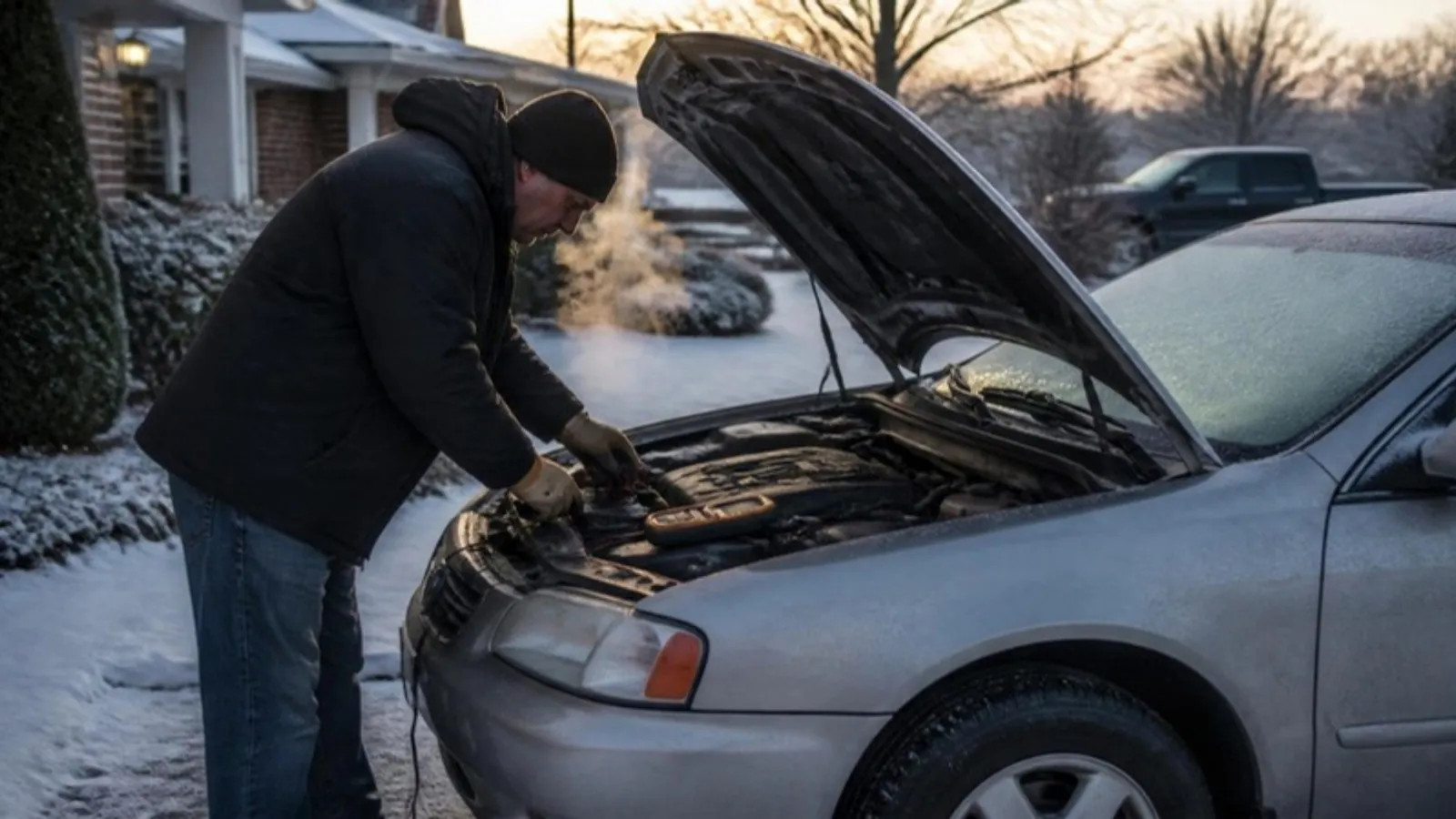
Why car batteries die in the cold: capacity loss, CCA, age, short trips and parasitic draw, plus voltage tests, block heaters and what to do if it won't start.
Short answer: Cold slows the chemistry inside a lead-acid battery, so it has less power right when the engine needs more to crank. AAA says a battery loses about 35% of its strength at 32 °F (0 °C) and about 60% at 0 °F (-18 °C). An older battery, short trips and small electrical drains push it over the edge, so test it in the fall and keep it charged.
Why cold weather kills batteries
Two things happen at once on a cold morning. The battery delivers less, and the engine asks for more. Thick, cold oil makes the starter work harder, and AAA notes a car may need up to twice the normal current to start when temperatures drop.
A low charge makes things worse. Interstate Batteries says a fully charged battery will not freeze until it gets far below zero, but a discharged one can freeze at about 15 °F (-9 °C). A frozen battery can be damaged for good, so keeping it charged matters more in winter than any other time.
CCA and battery age
Cold cranking amps (CCA) is the rating that matters in winter. OPTIMA Batteries explains the test: a new, fully charged battery is chilled to 0 °F (-18 °C), and CCA is the current it can deliver for 30 seconds while staying at or above 7.2 volts.
Match or beat the CCA your vehicle maker specifies. It is in the owner's manual or on the old battery's label. OPTIMA says a big surplus, like an extra 300 CCA, usually is not necessary.
Age is the other half. AAA puts the average battery life at three to five years. Consumer Reports, citing AAA data, says batteries last 58 months or more in the coldest northern parts of the US but less than 41 months in the hottest southern regions.
Check the date code on the sticker. Consumer Reports explains that a battery made in October 2025 shows 10/25, or a letter code where A is January, B is February, and so on. It also recommends an annual load test once a battery is 4 years old in a cold climate.
Short trips and parasitic draw
Every start pulls a lot of energy out of the battery. The alternator needs drive time to put it back. Interstate Batteries says 15 to 20 minutes of driving is usually enough under normal conditions, but a deeply drained battery can take many hours of driving, and a battery that needed a jump may never reach full charge without a plug-in charger.
Parasitic draw is the power used while the car is parked. A small amount is normal: the clock, the alarm and the computer memory. Trouble starts when something extra stays on:
• A glovebox, trunk or dome light that does not shut off
• Chargers or gadgets left plugged into a socket that stays powered with the engine off
• An aftermarket alarm, remote starter or stereo with a wiring fault
• A dash cam in parking mode without a low-voltage cutoff
If you run a dash cam while parked, our guide to dash cam parking mode and hardwire kits explains how a cutoff protects the battery.
How to test your battery with a multimeter
A basic multimeter costs little and tells you a lot. Set it to DC volts, red probe on the positive terminal, black on negative.
• Resting voltage: test after the car has sat for a few hours with everything off. Interstate Batteries says a charged battery should read 12.6 V or higher.
• Low reading: below 12.6 V, the battery is not fully charged. Put it on a charger and test again.
• Dead: Interstate considers a battery at 11.9 V or below dead.
• Engine running: the reading should rise to about 13.7 to 14.7 V. If it stays near 12 V, the alternator may not be charging.
Voltage only shows the charge right now, not how much life is left. A battery can read 12.6 V and still fail under load. A load test at a parts store or shop is the real check.
Block heaters and other ways to prevent a dead battery
In much of Canada, a block heater is standard winter gear. It warms the engine coolant, so the engine turns over more easily and the battery does less work. Natural Resources Canada recommends putting it on a timer set to come on no more than 2 hours before you start the engine.
• Have the battery tested in October or November, before the first deep freeze.
• Clean white or green crust off the terminals and make sure the clamps are tight.
• Take a longer drive once a week if most of your trips are short, or use a battery maintainer if the car sits.
• Turn off the heater blower, lights and accessories before you shut the engine off, so they are not loading the battery at the next start.
What to do when it won't start
Listen first. A rapid clicking or a slow, labored crank usually means a weak battery. Nothing at all, not even dash lights, can point to a loose or corroded terminal. Check the clamps before anything else. One exception to jumping: if the battery case is cracked or bulging, or you think it froze, do not jump or charge it. Have it replaced.
If the battery is low, jump it. Our step-by-step guide on how to jump start a car with a portable jump starter walks through the order of the clamps. Then drive for a good while, or better, put the battery on a charger. If it dies again within a day or two, get the battery and alternator tested.
For US drivers, our 4000A portable jump starter (maker's rating) handles gas engines up to 7.2 L and diesel up to 5.5 L, and doubles as a power bank with a light. The jump starter with air compressor covers gas up to 9.0 L and diesel up to 6.5 L, and adds a tire inflator up to 150 PSI with auto stop, handy when cold mornings drop your tire pressure too.
Frequently asked questions
Why does my battery die in winter but work fine in summer?
It was probably already weak. Summer starts take little effort, so a tired battery gets by. In the cold it loses capacity and the engine needs more current to crank, so the weakness shows.
What voltage should a car battery read in winter?
A charged battery should read 12.6 V or higher at rest, according to Interstate Batteries. If it reads lower, charge it and retest. At 11.9 V or below, it is considered dead.
How long should I plug in my block heater?
Natural Resources Canada recommends a timer set to switch on no more than 2 hours before you start the engine.
Sources
• AAA Oregon/Idaho: Winter Battery Preparation
• Consumer Reports: Car Battery Buying Guide
• Interstate Batteries: FAQs
• OPTIMA Batteries: What does Cold Cranking Amps (CCA) mean?
• Natural Resources Canada: Factors that affect fuel efficiency