
The 20-foot rule, where a generator must never run, how to place CO alarms, the symptoms of CO poisoning, and lights that need no fuel at all.
Short answer: run a portable generator outdoors only, at least 20 feet from windows, doors and vents, with the exhaust pointed away from the house. Never run it in a garage, basement, crawlspace, shed, porch or carport, even with doors and windows open. Install battery-powered or battery-backup carbon monoxide (CO) alarms on every level and near sleeping areas. If an alarm sounds or someone feels sick, get outside to fresh air and call 911. For light, you do not need a generator at all: battery and rechargeable lights burn no fuel.
Why generators are so dangerous indoors
Carbon monoxide is colorless and odorless. The CDC calls it a gas that kills without warning, and says more than 400 Americans die each year from unintentional CO poisoning not linked to fires, more than 100,000 visit an emergency department and more than 14,000 are hospitalized.
Portable generators are a big part of that during outages. The CPSC says one portable generator can produce as much carbon monoxide as hundreds of cars. In a February 2026 winter storm warning, the CPSC said an average of nearly 100 people die in the US each year from CO poisoning caused by portable generators, and that the poisoning can happen so fast that people may pass out before they notice symptoms like nausea, dizziness or weakness.
Where a generator can and cannot go
The CDC, Ready.gov and the CPSC agree on the distance. Here is how their guidance fits together:
• Outside only. The CPSC says never operate a portable generator inside a home, garage, basement, crawlspace, shed or other enclosed space. Opening doors or windows does not provide enough ventilation.
• At least 20 feet away. The CDC says more than 20 feet from windows, doors and vents. Ready.gov says at least 20 feet from windows, doors and attached garages.
• Not on the porch or in the carport. The CPSC says both are too close to the home.
• Exhaust pointed away. Direct it away from your home and other buildings' entrances, and close windows and seal vent openings near the generator or in the path of its exhaust (CPSC).
• Dry. Ready.gov warns that touching a wet generator or devices connected to it can cause electrical shock. The CDC says to place it where rain and snow will not reach it. The CPSC says to follow the manufacturer's instructions for bad weather, which may include an NFPA-rated noncombustible generator tent or waiting until the rain or snow passes.
Cords, fuel and features
• Connect appliances with heavy-duty extension cords. The CDC specifies individual heavy-duty, outdoor-rated cords.
• Let the generator cool before refueling. Ready.gov notes that fuel spilled on hot engine parts can ignite.
• Do not store gasoline indoors, where the fumes could ignite (CDC).
• If you are shopping for a generator, the CPSC suggests looking for one with a CO shut-off safety feature.
• Read and follow every label and the owner's manual.
Carbon monoxide alarms: the backup you cannot skip
An alarm is the only way most people will know CO is building up. What the agencies recommend:
• Type: battery-operated or battery-backup. A plug-in alarm with no battery backup stops working when the power goes out. The CDC specifically says to use a battery-powered or battery-backup CO detector when using a generator.
• Placement: on every level of the home and outside sleeping areas (CPSC), and near every sleeping area (CDC). The CPSC says interconnected alarms are best, because when one sounds, they all sound.
• Testing: the CPSC says to test CO and smoke alarms monthly. The CDC suggests checking batteries when you change your clocks in spring and fall.
• Replacement: follow the manufacturer's instructions or replace every 5 years, according to the CDC.
Know the symptoms, and what to do
The CDC lists the most common symptoms of CO poisoning as headache, dizziness, weakness, upset stomach, vomiting, chest pain and confusion. They are often described as "flu-like." People who are asleep, drunk or under the influence of other substances can die before they have symptoms. Infants, older adults and people with chronic heart disease, anemia or breathing problems are more likely to get sick.
If an alarm sounds or you suspect CO poisoning:
• Get everyone, pets included, outside to fresh air right away.
• Call 911. The CDC also lists your local Poison Control Center at 1-800-222-1222.
This is general safety information. Follow the instructions of 911 and medical professionals.
Other CO sources during a winter outage
Generators are not the only risk when people get cold and creative:
• Gas ovens and stovetops: never use them to heat your home (Ready.gov, CDC).
• Grills, charcoal and camp stoves: outdoors only. The CDC says never burn charcoal indoors.
• Cars: never run a car or truck in a garage attached to a house, even with the door open (CDC).
• Snow-blocked vents: the CPSC says to clear snow away from outside vents for fuel-burning appliances such as furnaces.
For keeping warm safely, see our guide to staying warm without power.
Light without fuel
Many people start a generator mainly to see. For light alone, a fuel-burning engine is not needed. The CDC recommends battery-powered flashlights and lanterns rather than candles or gas lanterns, and it lists fuel-burning lanterns among the sources of CO. Battery and rechargeable lights produce no exhaust at all.
The one catch: rechargeable lights must be charged before the storm. Options we carry, all shipping in the US:
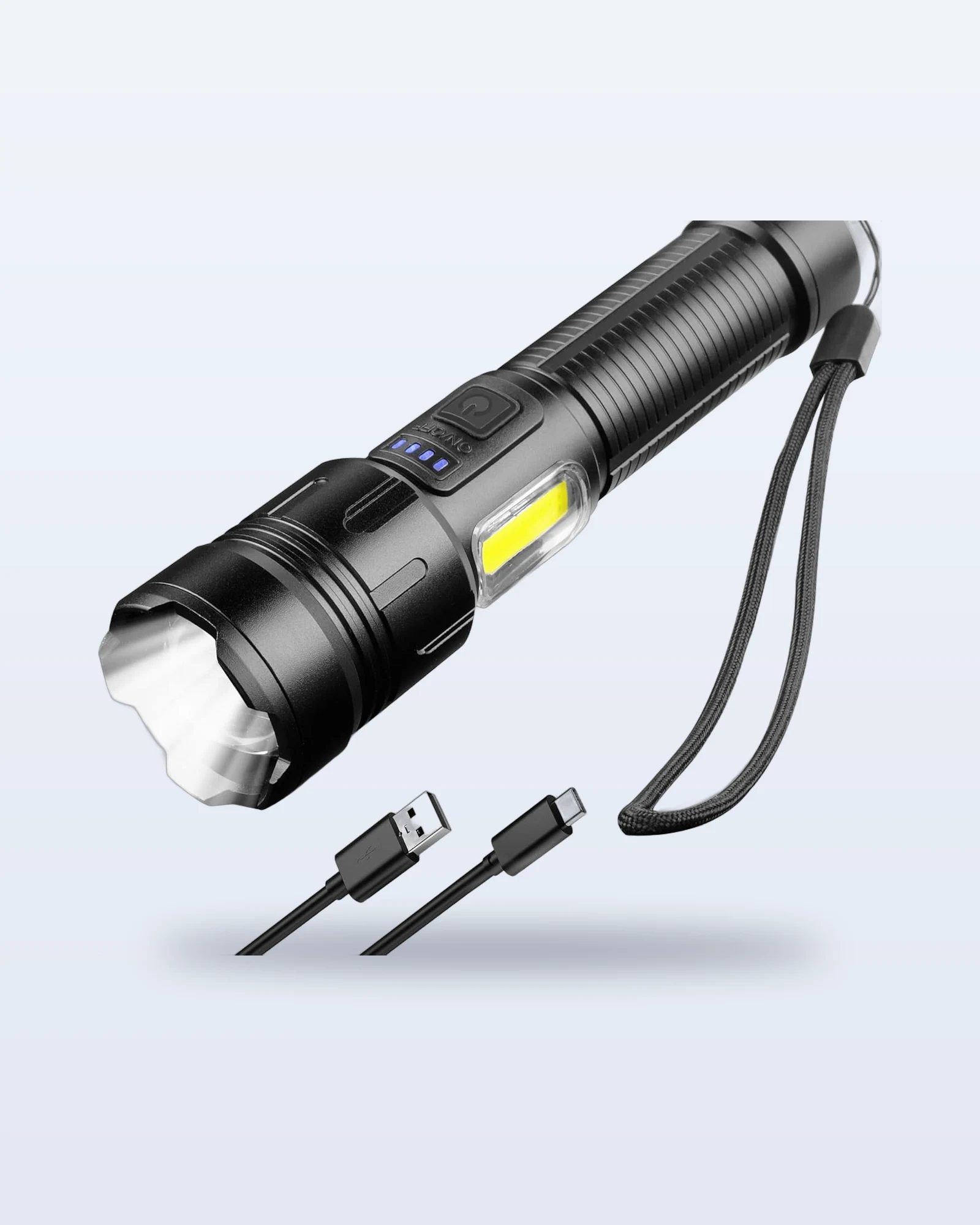
• Rechargeable Zoom Flashlight with COB Side Light ($39.99): zoom main beam, white and red COB side light, 1800 mAh battery, USB-C charging, IPX4 splash resistant. Ships within the contiguous US.
• Solar and USB Rechargeable LED Lantern ($29.99): 60 LEDs, 5 modes including SOS, recharges by USB or solar, with a USB port to top up a phone. The maker does not state battery capacity.
• Collapsible Solar Lantern with USB Output ($29.99): folds small, 3 modes, micro-USB or solar.
Solar recharging is slower than USB, but it works with no grid and no fuel, which makes it a useful backup during a long outage. Our blackout lighting guide explains where to place each light. See the rest in our Emergency collection.
Frequently asked questions
Can I run a generator in the garage with the door open?
No. The CDC and the CPSC both say never use a generator inside a home or garage, even if doors and windows are open.
How far from the house should a generator be?
At least 20 feet from windows, doors and vents, with the exhaust pointed away from the home, according to the CDC, Ready.gov and the CPSC.
Do I need a CO alarm if I do not own a generator?
Yes. Furnaces, fireplaces, gas ranges, stoves and cars also produce CO, according to the CDC. Ready.gov recommends CO detectors on every level of your home.
Sources
• CDC: Carbon Monoxide Poisoning Basics
• CDC: What to Do to Protect Yourself During a Power Outage
• CDC: Safety Guidelines During and After a Winter Storm
• CPSC: Carbon Monoxide Information Center
• CPSC: Winter Storm May Knock Out Power (February 2026)
• Ready.gov: Power Outages
• Ready.gov: Winter Weather