
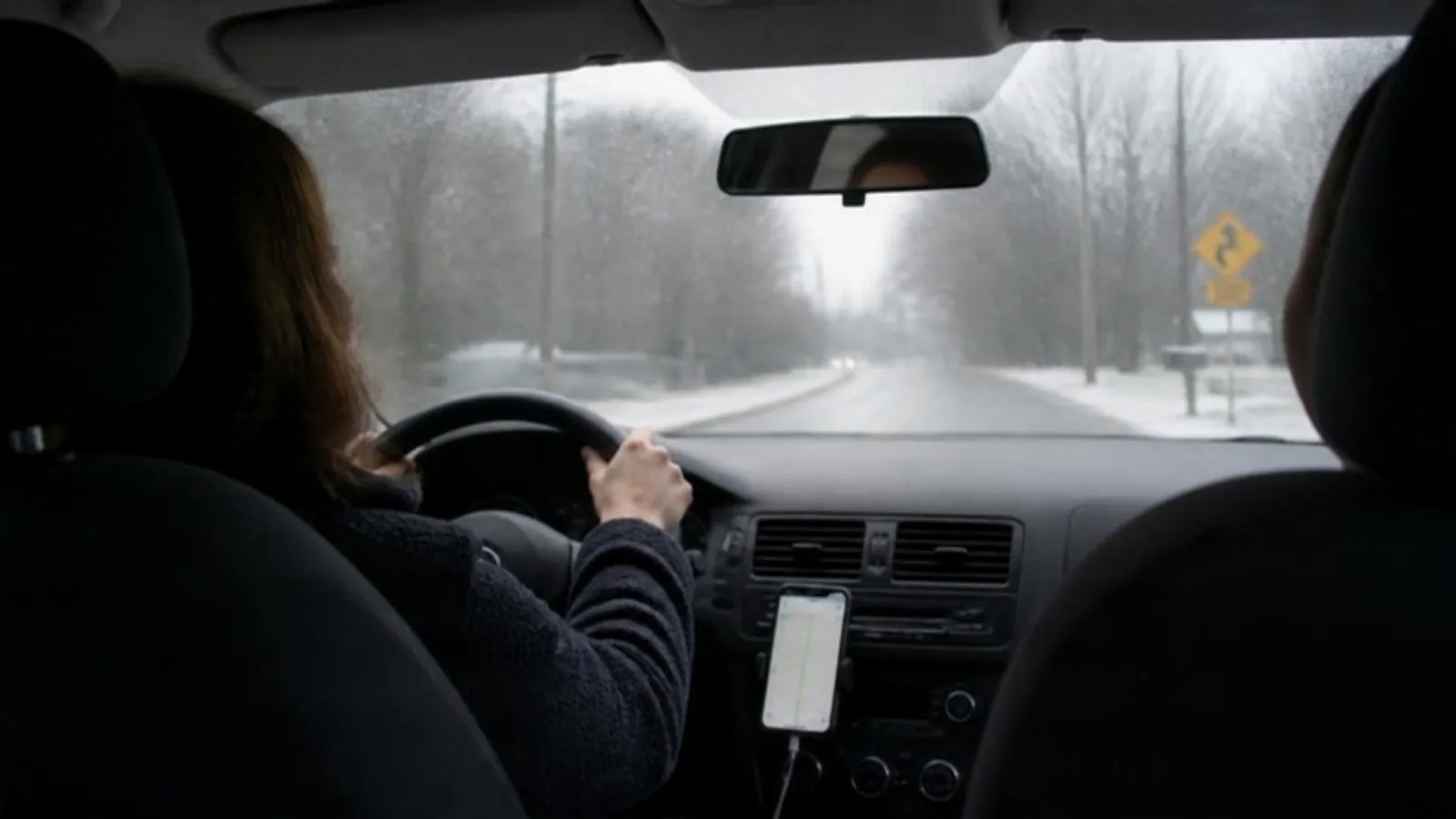
What hands-free means, which US states ban handheld phones, fines in Ontario, Quebec and BC, and where your phone mount can legally go in 2026.
Short answer: In most of the US and all of the provinces covered here, you can't hold your phone while driving. "Hands-free" generally means the phone sits in a secure mount and you use voice, Bluetooth or a single tap to start or end a call. Fines run from a few hundred dollars to several thousand for repeat offences, so check your own state or province's rules before you set up your mount. This is general information, not legal advice.
What "hands-free" actually means
The wording changes from place to place, but the idea is close everywhere: the phone stays out of your hand. A few examples from the official sources:
• California: the phone must be mounted, and you may touch it only with a single swipe or tap to turn a feature on or off. Texting or scrolling with repeated taps is not covered.
• Ontario: you can use a hands-free device with an earpiece or Bluetooth, and with a securely mounted phone you may only touch a button to make, answer or end a call.
• British Columbia: fully licensed drivers can use a device that is securely fixed to the car or worn on the body, with one touch to start, accept or end a call.
• Quebec: simply holding a portable device while driving is illegal, whatever you are doing with it.
If you need to type, pull over somewhere you're allowed to stop.
Handheld bans in the US
According to the Governors Highway Safety Association (GHSA), 33 states plus Washington, D.C., Puerto Rico, Guam, the Northern Mariana Islands and the U.S. Virgin Islands ban all drivers from using a handheld phone. Texting while driving is banned for all drivers in 49 states plus D.C. and those territories. GHSA's summary was last updated in October 2025, and states keep passing new laws, so treat these counts as a snapshot.
• Arizona, California, Connecticut and Delaware have handheld bans with primary enforcement, meaning police can stop you for that alone.
• Colorado's handheld ban took effect on January 1, 2025.
• Alabama and Missouri have handheld bans with secondary enforcement, so you'd need to be stopped for something else first.
• Arkansas and Florida limit their handheld bans to school and work zones.
Look up your state's DMV or highway safety office for the current text of the law.
Fines in Ontario, Quebec and British Columbia
Ontario (fully licensed drivers):
• First conviction: $615 if settled out of court, up to $1,000 with a summons or in court, plus 3 demerit points and a 3-day licence suspension.
• Second conviction: up to $2,000, 6 demerit points, 7-day suspension.
• Third and later: up to $3,000, 6 demerit points, 30-day suspension.
• G1, G2, M1 and M2 drivers face the same fines with no demerit points, but a 30-day suspension on the first conviction and 90 days on the second. A third conviction cancels the licence.
Quebec: a fine of $300 to $600 and 5 demerit points. A repeat offence within two years brings the minimum fine to $600 and an immediate licence suspension: 3 days the first time, 7 days the second, 30 days after that.
British Columbia: a fine of $368 and 4 penalty points, plus an ICBC penalty point premium. Two or more tickets in three years trigger the Driver Risk Premium, and the total can reach as much as $2,000. Drivers in the Graduated Licensing Program can't use any electronic device while driving, hands-free included.
These are the amounts posted on the official sites when we checked in October 2026. Amounts change, so confirm on your province's site.
Where a phone mount can legally go
Windshield rules differ a lot.
• California allows a phone on the windshield only where a GPS can go: within a 7 inch (about 18 cm) square in the lower corner farthest from the driver, or a 5 inch (about 13 cm) square in the lower corner nearest the driver. Dashboard and center console mounts are fine if they don't block your view.
• Quebec requires a fixed support that holds the device firmly. A phone in a cup holder or on the passenger seat doesn't count. The screen can't block your view, hide gauges like the speedometer, or get in the way of airbags or defrosters, and it may only show information that helps with driving, such as GPS directions.
• British Columbia says the device must be securely fixed, within easy reach of the driver's seat, and must not block your view to the front or sides.
• Ontario requires the device to be securely mounted.
Other states have their own windshield obstruction rules, and some are strict about anything stuck to the glass. If you're unsure, a dash, vent or console mount is the safer bet. The same logic applies to dash cams, which we cover in are dash cams legal in the US and Canada.
Safe setup tips
• Put the phone low and close to your normal line of sight, so a glance at the map doesn't pull your eyes far off the road.
• Keep it clear of airbag doors, the instrument cluster and defroster vents.
• Set your destination and music before you shift into drive.
• Turn on your phone's driving or do not disturb mode so messages wait until you park.
• Pair Bluetooth once, at home, and test voice commands in the driveway.
• Route the charging cable so it can't tangle around the gear selector or steering wheel.
For US drivers, our dashboard clamp phone mount keeps the phone off the glass, and the wireless charging car phone mount charges it while you navigate, so you're not fiddling with a cable at every stop. Both mounts ship to the US only.
Frequently asked questions
Can I use my phone at a red light?
Don't count on it. Ontario, BC and Quebec rules apply while you're driving, and Quebec's SAAQ advises using voice commands or stopping in a safe place where stopping is allowed. Check how your state or province treats a stop in traffic.
Can I use GPS on my phone?
Generally yes, if the phone is in a proper mount and you aren't typing while moving. Quebec lists GPS directions as allowed screen content. BC novice drivers in the GLP can't use any device, GPS included.
Are Bluetooth earpieces allowed?
Ontario lists earpieces, lapel buttons and Bluetooth as permitted hands-free options. Rules on headphones vary by state, so check locally.
Sources
• GHSA: Distracted Driving State Laws
• Government of Ontario: Distracted driving
• SAAQ: Appareils électroniques portatifs (feuillet)
• Province of British Columbia: Use of electronic devices while driving
• California Office of Traffic Safety: New Driver Cell Phone Law Taking Effect on Jan. 1, 2017