
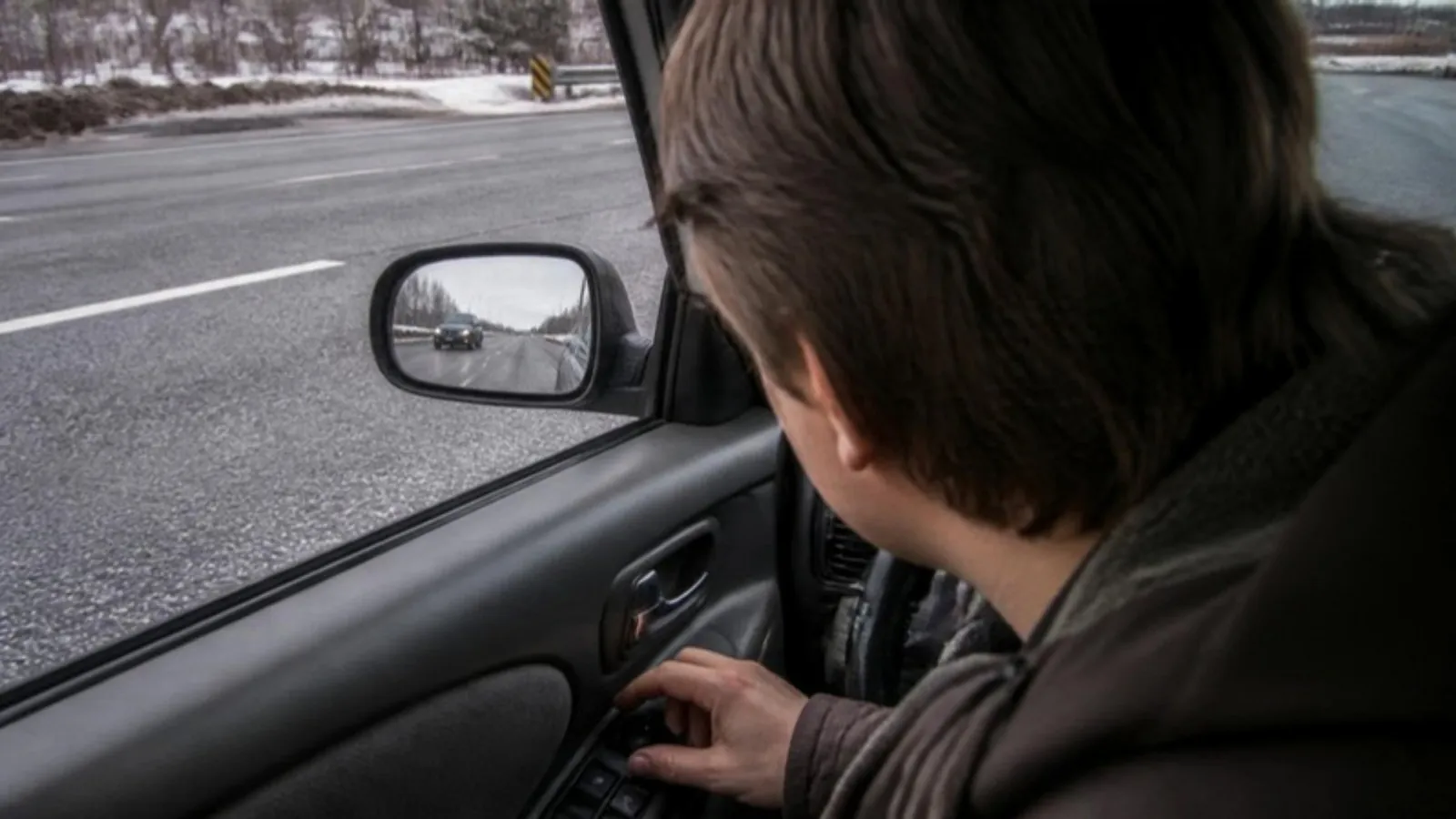
Set your side mirrors the wide SAE way, step by step for each side, place convex blind spot mirrors right, and learn why shoulder checks still matter.
Short answer: Turn your side mirrors out until your own car just disappears from them. Lean your head against the driver's window to set the left mirror, lean to the middle of the car to set the right one, and set the rearview mirror to frame the whole back window. You will still have small blind spots, so a quick shoulder check before every lane change stays part of the routine.
Why the usual mirror setting leaves a gap
Most of us were taught to set the side mirrors so we can see a good slice of our own car. It feels reassuring. The problem is that your rearview mirror already shows what's straight behind you, so the side mirrors end up showing the same thing again. The lane beside you, where a car sits just off your rear bumper, falls in the gap between them.
In 1995, engineer George Platzer published an SAE technical paper on the geometry of rearview mirrors and why blind zones exist. His fix, often called the SAE or BGE (Blindzone Glare Elimination) setting, aims the side mirrors further out so each mirror picks up where the rearview mirror leaves off. AAA's driver training manager describes it as canting the side mirrors outward about 15 degrees. NHTSA gives the same basic instructions.
Driver side mirror, step by step
• Sit the way you normally drive, seat and steering wheel already set. Mirrors come last.
• Lean left until your head touches the driver's window.
• From that position, adjust the left mirror so you can just see the side of your car at the inner edge.
• Sit back up. Your car should now be out of the mirror, or barely in it. That's the point: the mirror now looks at the next lane instead of your own door.
Passenger side mirror, step by step
• Lean right until your head is roughly over the center console, the middle of the car.
• Adjust the right mirror so you can just see the right side of your car at its inner edge.
Expect it to feel strange for the first few days. You lose the "my car is there" reference and gain a view of the lanes. Give it a week of normal driving before you decide.
Rearview mirror and a quick test
Set the inside mirror so it frames the entire rear window, centered. You should not see your headrest, the ceiling or your own face.
Now test it on a multi-lane road, in daylight, with light traffic. Watch a car come up behind you in the next lane. It should show up in the rearview mirror, then appear in the side mirror as it starts to leave the rearview, then show up in your peripheral vision as it leaves the side mirror. If it vanishes for a moment along the way, nudge that side mirror a little and try again. AAA also suggests having someone walk around the car while you sit in the driver's seat, so you learn exactly where you can and can't see.
Shoulder checks still matter
Even the wide setting doesn't close every gap. NHTSA's own instructions end with the reminder to look over your shoulder before changing lanes. Motorcycles and cyclists can still tuck into a spot your mirrors miss.
Winter makes this worse. Below 32 °F (0 °C), slush, road salt and frost cover mirrors fast. Clear them before you leave, use the heated mirror button if your car has one, and wipe them at fuel stops. If you're putting together a cold weather bag, our winter car emergency kit checklist covers the basics.
Convex blind spot mirrors and where to put them
Small round convex mirrors stick onto your side mirrors and show a wider, smaller image of the lane next to you. They help drivers who struggle with the wide setting, drivers of long vehicles, and anyone who shares a car and doesn't want to readjust every time.
• Put them in an outer corner of the side mirror, away from the car body.
• Upper or lower outer corner? The Canada Safety Council says there are conflicting schools of thought, and no one-size-fits-all answer. Try the upper outer corner first, since it keeps the lower part of the main mirror clear for curbs and lane lines. If it doesn't work for your seat height, move it.
• Clean the mirror glass with rubbing alcohol and let it dry before sticking. Cold glass doesn't bond well, so do it in a warm garage or on a mild day.
• Angle a rotating mirror so it shows the lane beside your rear wheel, not the sky or your own door.
• Remember that convex glass makes things look farther away than they are. Use it to spot a car, then confirm with a shoulder check.
If you want to try one, our blind spot mirrors 2-pack gives you two round convex stick-on mirrors that rotate, one for each side.
Blind spot monitoring has limits too
Blind spot warning systems are handy, but they're a backup, not a replacement for mirrors and your eyes. In AAA's testing with the Automobile Club of Southern California, the systems detected motorcycles 26 percent later than passenger cars. They also had trouble detecting fast-moving vehicles, for example when merging onto a busy highway, and in some cases warned only when the other vehicle was a few feet away. A Canadian driving instructor quoted by The Globe and Mail adds another gap: the system won't warn you about a car moving from two lanes over into the same space you're aiming for.
Snow, slush and road grime can also cover the sensors, which usually sit in the rear bumper. Your owner's manual explains what your car does when they're blocked. Set your mirrors well and keep turning your head.
Frequently asked questions
Is it bad if I can't see my own car in the side mirrors?
No. That's how the wide setting is supposed to look. You use the rearview mirror for what's behind you and the side mirrors for the lanes beside you.
Does the wide setting work on trucks and SUVs?
Yes, the same steps apply. If you tow a long trailer, follow the towing mirror guidance for your setup.
Do I still need blind spot mirrors if I use the wide setting?
Many drivers don't. They're useful if you share the car, drive something long, or just like the extra view. They don't replace the shoulder check either way.
How often should I check my mirror setting?
Every time you change the seat, after someone else drives, and after a car wash or a hit from a snowbank. It takes ten seconds.
Sources
• NHTSA: Minimize Blind Spots Using Outside Mirrors
• SAE International: The Geometry of Automotive Rearview Mirrors, Why Blind Zones Exist and Strategies to Overcome Them (Platzer, 1995)
• AARP: How to Adjust Your Car Mirrors to Avoid Blind Spots (with AAA's driver training manager)
• AAA: Blind Spot Monitoring and Lane Departure Warning Testing
• The Globe and Mail: Is there a right spot for a blind-spot mirror?