
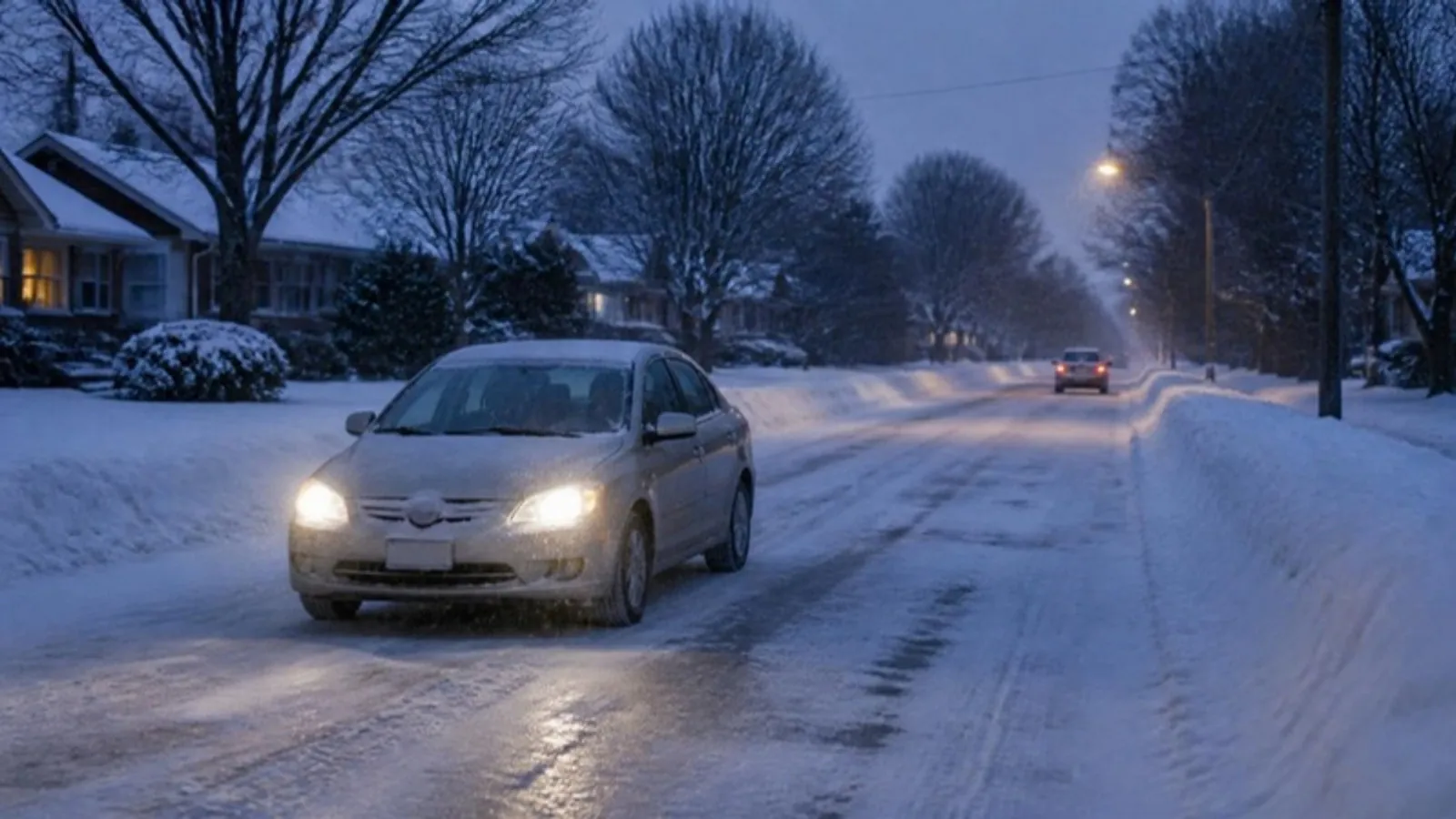
How to drive on snow and ice: following distance, ABS braking, front and rear skids, black ice, hills, and winter tire rules in Quebec and BC.
Short answer: Slow down, leave 8 to 10 seconds of space to the car ahead, and make every input gentle: brake, then turn, then accelerate. If your car has ABS, press the brake firmly and hold it. If you skid, ease off the pedals and look and steer where you want to go.
Before you pull out: see and be seen
Winter driving starts in the driveway. Brush off the whole car, not a mail slot on the windshield. Ontario's winter driving page tells drivers to clear ice and snow from the windows, lights, mirrors and roof before leaving.
In some places it is also the law. Here is what the official sources say:
• Quebec: the SAAQ says the windshield and windows must be cleared of anything that reduces the driver's view (fine of $100 to $200 plus costs), and you may not drive with snow or ice on the vehicle that could come loose and endanger others (fine of $60 to $100 plus costs).
• Pennsylvania: PennDOT asks drivers to remove snow and ice from the hood and roof, and says you can be ticketed if snow or ice from your vehicle hits a person or vehicle and causes death or injury.
• Elsewhere: rules vary, so check with your state or province.
Keep the tank at least half full, as Ontario, AAA and PennDOT recommend. If you ever get stuck and run the engine for heat, PennDOT says to keep the tailpipe clear of snow and crack a downwind window.
Following distance and speed
AAA says the normal 3 to 4 seconds of following distance on dry pavement should grow to at least 8 to 10 seconds on slippery roads. Pick a pole, wait for the car ahead to pass it, and count.
Speed is the other half. Ontario notes that many winter collisions happen because drivers go too fast for the conditions. A few habits that help:
• Accelerate, turn and brake gradually. Hard inputs break traction.
• Brake first, then turn, then accelerate. Asking the tires to do two jobs at once is how skids start.
• Skip cruise control on wet, snowy or icy roads. Ontario and PennDOT both say so.
Braking with and without ABS
With ABS, AAA's advice is simple: press hard and stay on the pedal. When ABS works you will feel the pedal vibrate and pulse under your foot. That is normal. Do not pump the brakes and do not lift off.
Without ABS, use threshold braking: keep your heel on the floor and squeeze with the ball of your foot, just short of locking the wheels. If they lock, ease up a little and squeeze again.
Better still, brake early, on clear pavement, before stop signs and lights where ice tends to form.
Skids: front wheels vs rear wheels
• Front-wheel skid (understeer): you turn the wheel and the car keeps plowing straight. Ease off the gas and the brake so the front tires can grip again. Straighten the wheel slightly, then steer gently where you want to go once you feel grip come back.
• Rear-wheel skid (oversteer or fishtail): the back of the car slides out. Ease off the pedals, look where you want to go and steer there. Use small corrections. As the car straightens, be ready to unwind the wheel so you do not swing the other way.
Ontario sums it up: release the brakes, steer in the direction you want to go, and do not steer too far or the car could spin. Look at the open lane, not the ditch.
Black ice, bridges and hills
Black ice is a thin, clear glaze that looks like wet road. Ontario's tip: winter asphalt should look grey-white. Black and shiny means ice. Shaded spots, bridges and overpasses freeze earlier than the rest of the road, so lift off the gas before you get there and keep the wheel steady.
Hills need a plan. AAA says not to power up a snowy hill, because extra gas just spins the wheels. Build a little momentum on the flat, let it carry you up, then slow down at the crest and go down as slowly as you can. Try not to stop partway up an icy hill.
In heavy or blowing snow, PennDOT says to use low beams. High beams bounce off the flakes. If you cannot see, pull off somewhere safe and wait.
Winter tires: Quebec and BC rules
Tires matter more than drive type. Ontario says winter tires can shorten braking distances by as much as 25% and that all-season tires can start to lose grip at 7 °C (about 45 °F). Look for the three-peak mountain snowflake symbol, and put winter tires on all four wheels.
• Quebec: winter tires are mandatory from December 1 to March 15 on vehicles registered in Quebec, rentals included. Tires must carry the official pictogram or be studded. The fine is $200 to $300.
• British Columbia: winter tires or chains are required on most designated routes from October 1 to April 30, with some routes ending March 31. BC accepts tires marked M+S or with the mountain snowflake, with at least 3.5 mm of tread, and recommends the mountain snowflake for snow and ice.
Confirm on the official pages below. Cold air also drops tire pressure, so check it often. Our guide on tire pressure in cold weather explains how much and why.
What to keep in the car
Ontario's winter survival kit list is a solid baseline: a charged phone, water and non-perishable food, a flashlight, a blanket and warm clothes, jumper cables, a shovel, traction mats or sand, plus candles and matches or a lighter. Add an ice scraper and washer fluid rated to -40 °C (-40 °F). Our winter car emergency kit checklist covers the full list.
A plug-in tire pressure monitor uses four valve-cap sensors and shows pressure and temperature on a display in your 12V socket, so you notice a cold-morning drop before it affects grip. And a 2K front and rear dash cam records both directions with loop recording, which helps if someone slides into you at a light.
Frequently asked questions
Should I pump the brakes on ice?
Only if your car has no ABS, and even then threshold braking works better. With ABS, press firmly and hold. The pulsing pedal means the system is doing the pumping for you.
Is all-wheel drive enough without winter tires?
No. All-wheel drive helps you get moving, but it does not help you stop or turn. That grip comes from the tires.
How much following distance do I need on snow?
AAA recommends at least 8 to 10 seconds on slippery roads, compared with 3 to 4 seconds on dry pavement. On glare ice, leave more.
Sources
• AAA Colorado: Driving Tips for Snowstorms
• Government of Ontario: Winter driving
• SAAQ: Winter Driving
• Québec.ca: Requirements for winter tires
• Province of British Columbia: Designated Winter Tire and Chain Routes
• Province of British Columbia: Passenger Vehicle, Tire and Chain Requirements
• PennDOT: Winter Driving