
How to escape a sinking car: seatbelt, window, children, out. Why doors stay shut, and why many newer cars have laminated side glass that tools can't break.
Short answer: Get out through a window, fast, while the car is still floating. Follow the order cold water researcher Gordon Giesbrecht teaches: seatbelt off, window open or broken, children out (oldest first), then everyone out. Do not stop to call 911 and do not try the door.
Why the first minute matters
When a car goes into water, it usually floats for a short time. NPR's 2024 report on submerged vehicles puts the window to act at about a minute. Giesbrecht, a professor emeritus at the University of Manitoba who ran the Operation ALIVE research on sinking cars, describes that early moment simply: "When you first end up in the water, you're in a boat with a big leak."
His team's research estimates about 400 people a year die in submerged vehicles in North America. The old advice was to wait for the car to fill with water so the pressure equalizes, then open the door. His experiments tested that idea and led to a different plan: leave right away, while the side windows are still above the waterline. In his words, "There are no good scenarios where waiting increases your chance of survival."
The escape order: seatbelt, window, children, out
• Seatbelt off. Unbuckle yourself first, then tell everyone else to unbuckle.
• Window open. Try the power window right away. The electrics may still work in the first moments, so do not wait. If it will not move, break a side window with an escape tool. Aim near a corner of the glass.
• Children out, oldest first. Giesbrecht's advice is to push children out first, starting with the oldest. Older kids can hold on to the car or stay afloat while you pass out the younger ones.
• Out. Climb out through the window and get onto the roof or swim to shore. Once you are out of a sinking car, getting back in is very hard, which is why the kids go before you.
Practice saying it out loud with your family once: seatbelt, window, children, out. In a panic, people do what they have rehearsed.
Why you should not call 911 first
Normally, calling 911 is step one after a crash. In water, it is not. AAA's own escape plan says to call 911 after you get out when the car is in water or on fire. The University of Manitoba page on Giesbrecht's work also warns against using a cell phone in a sinking car. A call takes time you do not have. Call from the roof of the car or from the shore.
Why the doors will not open
As the car settles, water pushes on the outside of the doors. A door is a large flat surface, so even a small difference in water level adds up to a lot of force, far more than most people can push against. Giesbrecht's guidance is to use the window, not the door, because water pressure makes the door very hard to open. Open the window early, while it is still above the waterline, and you never have to fight that pressure.
Tempered vs laminated side windows
There are two kinds of car glass:
• Tempered glass shatters into small pieces when a spring loaded or hammer tool hits it. Most older cars use it for side and rear windows.
• Laminated glass has a plastic layer between two sheets. It cracks but holds together. Windshields are laminated, and many newer cars use it on side windows too, to help keep people inside the car in a crash.
AAA tested six escape tools. Four broke tempered glass. None of them broke laminated glass, even after the glass cracked. AAA also found that about 1 in 3 model year 2018 vehicles have laminated side windows, often only in the front, with tempered glass in the rear.
So check your own car today. Look in the bottom corner of each side window for a small label that says TEMPERED or LAMINATED. If there is no label, ask the dealer or manufacturer. If your front windows are laminated, your planned exit is a tempered rear side window, and everyone in the car should know which one. If no window opens and none can be broken, AAA's last resort is to move to an air pocket, wait until the car fills and the pressure equalizes, then open a door. Treat that as a backup only.
Trapped after a crash on land
After a rollover or a hard hit, a jammed door or a stuck belt can keep you in. Here the order changes:
• If there is no fire, smoke or water, call 911 first. Turn on your hazard lights.
• If you are hurt, or think you might have a neck or back injury, stay still and let firefighters get you out.
• If the car is upside down, brace yourself with one hand on the roof before you release the belt, so you do not drop on your head.
• If there is fire or smoke and the doors will not open, break a tempered side window and get out, then call.
Keep a breaker where you can reach it
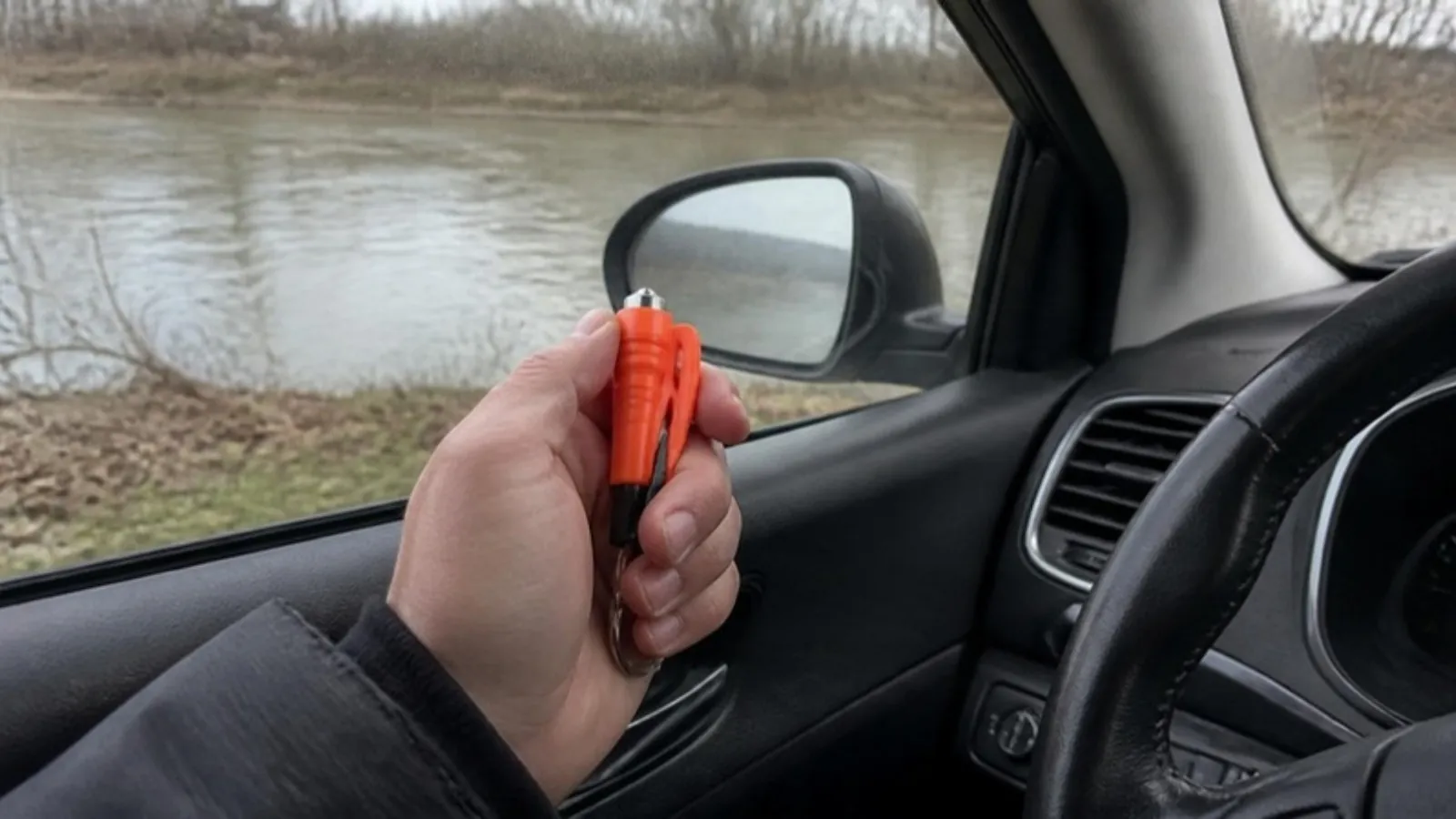
A tool in the glove box or the trunk is no help when you are belted in and the car is moving. Keep it on your key ring, in the door pocket or mounted near the steering column. Our car window breaker tool has a tungsten steel tip and is made for side windows only. It will not break a laminated windshield, and like every tool AAA tested, do not count on it for laminated side glass. Keep it within the driver's reach and know which of your windows are tempered. If you are building a winter kit, our winter car emergency kit checklist covers the rest.
Frequently asked questions
Can I break the windshield to escape?
No. Windshields are laminated, and escape tools are not designed to break them. Use a side or rear window.
Should I wait for the car to fill with water before opening the door?
Not as a plan. Giesbrecht's research found that waiting lowers your chances. AAA lists it only as a last resort if no window can be opened or broken.
How do I know if my side windows are laminated?
Look for a label in the lower corner of each window that says TEMPERED or LAMINATED. Some cars mix both, laminated in front and tempered in the rear. If you cannot find a label, ask the manufacturer.
Sources
• University of Manitoba: Gordon Giesbrecht, PhD
• NPR: How to escape a submerged vehicle
• AAA: Vehicle Escape Tools
• AAA Oregon/Idaho: Laminated Glass Doesn't Give Drivers a Break