
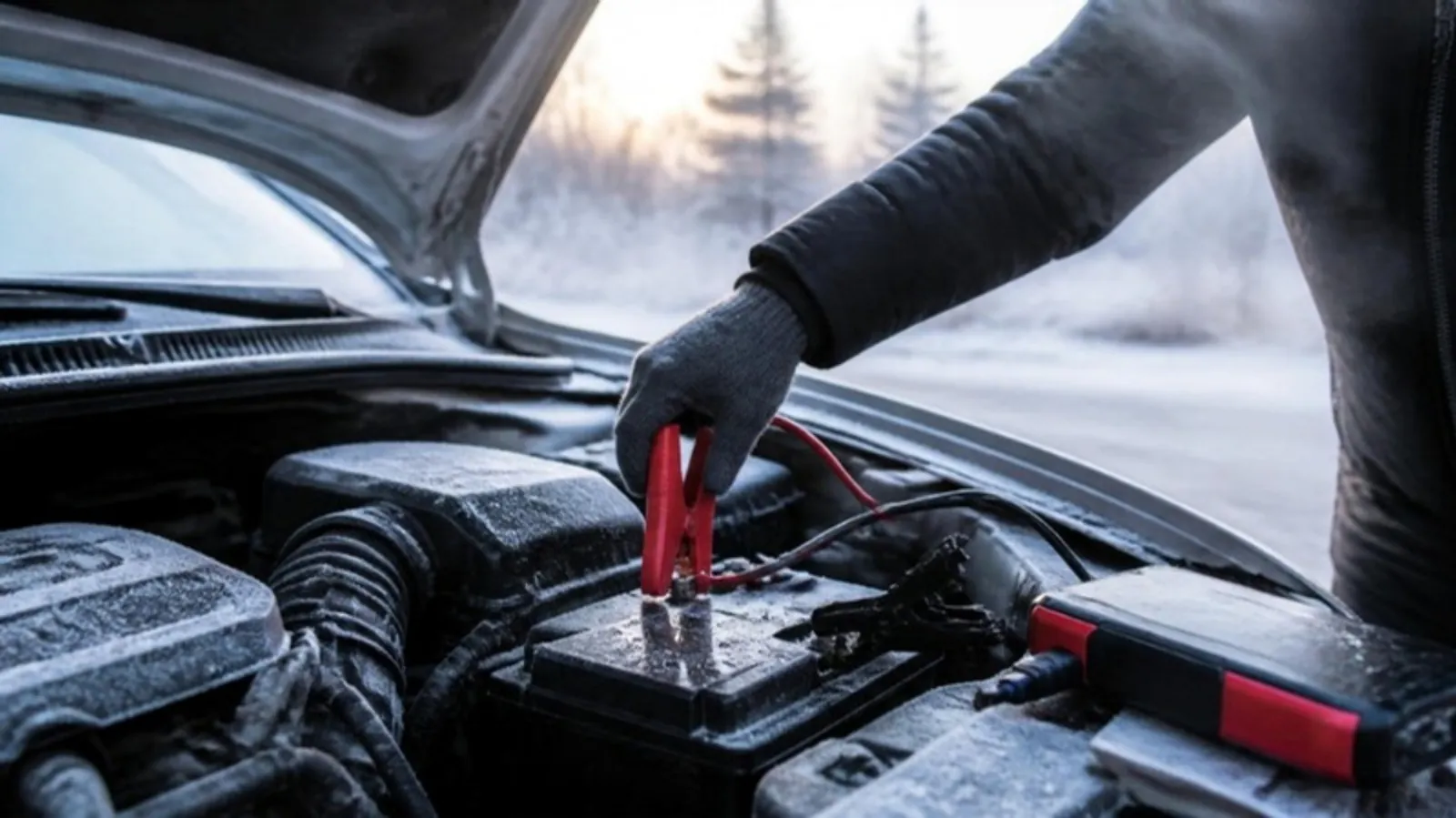
Cold cuts a battery's starting power by up to 60%. Here is how to use a portable jump starter safely, step by step, and how to read the amp numbers on the box.
Short answer: turn everything off, clamp red to the positive terminal, clamp black to bare metal on the engine or chassis, switch the pack on if it asks, then start the car. Remove black first, then red. Never jump a battery that is cracked, leaking or frozen.
Why batteries die in winter
According to AAA, a battery loses about 35% of its starting strength at 0 °C (32 °F) and about 60% at -18 °C (0 °F), while a cold engine can need up to twice the current to turn over. CAA-Québec handled 14,759 battery boosts between December 22, 2025 and January 5, 2026, almost double the 7,545 of the same period a year earlier.
Step by step
• Check: ignition off, lights and heater off. Look at the battery. If it is cracked, swollen, leaking or frozen, stop and call for help.
• Red clamp: attach it to the positive (+) terminal.
• Black clamp: attach it to unpainted metal on the engine block or chassis, away from the battery, or to the ground point in your owner's manual.
• Power on: switch on the jump starter if your model requires it and wait for the ready light.
• Start: crank the engine. If it does not start, wait as your pack's manual says before trying again; one maker limits each try to 6 seconds with 3 minutes of rest.
• Remove: once running, switch the pack off, remove black first, then red. Keep clamps apart and away from moving parts.
Then drive for at least 20 to 30 minutes, or have the battery tested. A battery that needs a boost every morning needs replacing.
Reading the amps on the box
"Peak amps" is a split-second maximum with no common standard. Cranking amps (CA) are measured for 30 seconds at 0 °C, and cold cranking amps (CCA) for 30 seconds at -18 °C. When you compare packs, look at the engine size each one is rated for, not peak amps alone.
Storing a lithium jump starter in the car
Check your model's temperature range. One major brand lists storage and use from -20 °C to 50 °C but charging only from 0 °C to 40 °C. In a deep freeze, keep the pack inside and bring it to the car when needed. Recharge it every few months and before winter.
Which one to keep in your car
Our 4000A Jump Starter is rated for gas engines up to 7.2 L and diesel up to 5.5 L. The Jump Starter with Air Compressor covers gas engines up to 9.0 L and adds a 150 PSI tire inflator. For small cars and a weak battery, the Slim Jump Starter fits in the glove box.
Frequently asked questions
Can a jump starter damage my car?
Used as the manual says, no. Most packs have reverse-polarity protection. Never connect to a damaged battery.
How many jumps per charge?
It depends on the pack, the engine and the cold. Recharge after each use to stay ready.
Is a jump starter better than jumper cables?
You do not need a second car or a stranger's help, which matters on a cold night or an empty road.
Sources
• AAA Oregon/Idaho: winter battery preparation
• Clore Automotive: peak amps don't tell the whole story
• NOCO GB40: how to use
• CAA-Québec: holiday 2025-2026 roadside report